
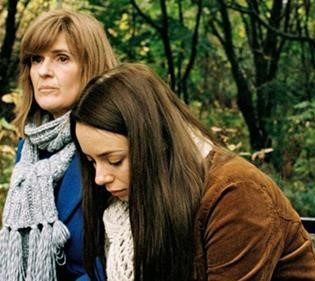

Shunning, the cutting-off of all communication practised by the Jehovah’s Witnesses, is presented as a “loving measure”, yet it destroys families. This is portrayed vividly in the recent film Apostasy, which tells the story of life among Jehovah’s Witnesses from the inside. Its director, Daniel Kokotajlo, was a Jehovah’s Witness for ten years: handing out copies of The Watchtower (the magazine the Witnesses publish monthly) in the street, attending meetings at the Kingdom Hall and knocking on doors in an effort to help people gain eternal life.
It is the story of a mother and her two daughters.
The younger daughter, Alex (Molly Wright), still feels guilt and shame because she was given a blood transfusion as a small child. She would have died without it, but the Jehovah’s Witnesses regard such an act as an “abuse” of the body. The elder daughter, Luisa (Sacha Parkinson), begins to question the system of beliefs imposed on her. When she becomes pregnant after a relationship with a non-Witness, she is expelled from the congregation. The mother, Ivanna (Siobhan Finneran), believes in the organisation’s teaching so strongly that for the sake of her faith she is ready to sacrifice her relationship with her daughters.
The director succeeds in revealing several important aspects of Witnesses’ lives: the ban on blood transfusion, the devaluing of secular higher education, and the attitude towards relatives who have been shunned. He also conveys the emotional experience of an ordinary Witness: fear, guilt, disappointment, anger and doubt about whether the decisions made are the right ones.
When we talk about Witnesses who shun their relatives, the blame usually falls on the person who, following the elders’ orders, cuts off contact. But before condemning a Witness relative, we should consider the psychological pressure that person is under. It is clearly visible in the scene where a congregation elder reminds the mother that Jehovah God knows best how to act, “even better than a loving mother”. The inner struggle between a mother’s love and her sense of responsibility to the organisation’s rules is plain to see. Her eyes are empty, and her vacant stare shows only a trace of doubt about whether the organisation is right. So after the “Judicial Committee”, the mother does her best to convince her daughter that Jehovah’s love is conditional, and that “you have to work really hard to earn that love.”
This is one of the issues I meet most often in my work supporting former members of high-control groups: guilt.
While a person is part of the Jehovah’s Witness organisation, they feel guilty about:
- not being good enough for God;
- not carrying out the organisation’s principles well enough (and these often change);
- what they do behind closed doors, in secret from the congregation elders.
Those who have left feel even more guilty about:
- letting themselves be deceived by other people;
- having spent many years serving other people’s goals within the organisation;
- having introduced people to the organisation who are still part of it, and being unable to get family members and friends out;
- the way they left (wishing they could go back and do it differently).
They carry this guilt, and the sense of rejection, as a burden for many years after leaving. In the film, the daughter asks her mother, “Do you know what it’s like to think that the Almighty Jehovah is punishing you… constantly? Even when I truly repent?” And the mother replies, “You have to earn his love, for it is conditional. It takes strength to live by his standards.”
Imagine having your parents, brothers, sisters and relatives in this organisation since childhood. What would expulsion from the congregation mean to you? It would mean losing your family and all your friendships with those who remain Jehovah’s Witnesses. If you were living away from home, or were forced to leave it, none of them would come to help you. You would see them as little as possible. And this kind of family destruction is presented as a standard of devotion to God.
How different this is from the attitude of the daughter, who cannot rejoin the Witnesses. Like many former Jehovah’s Witnesses, she says to her mother, “I really don’t blame you. And I understand if you don’t want to talk to us anymore. But I will always be here if you need me.”
You can find more information about the film here: