
FECRIS Conference 2017 in Brussels
Excessive cult influence and the process of radicalisation, 19–20 May 2017
The umbrella organisation FECRIS (the European Federation of Centres of Research and Information on Cults and Sects), whose members include the Finnish victim-support organisation UUT, held its annual international conference in Brussels on 19 May 2017. Laura Laukkanen attended as UUT’s representative and also took part in the FECRIS annual general meeting on 20 May 2017. This year the conference theme was “Excessive Cult Influence and the Process of Radicalisation: A Matter for Discussion”. One of the most important topics was therefore religious radicalisation and understanding what is happening. Several speakers stressed that people’s knowledge of the subject needs to grow and that different disciplines must work closely together on the phenomenon. The importance of prevention was also emphasised. The conference featured current presentations by researchers and practitioners on the subject, as well as personal accounts from speakers about the scale of cult activity and religious extremism.
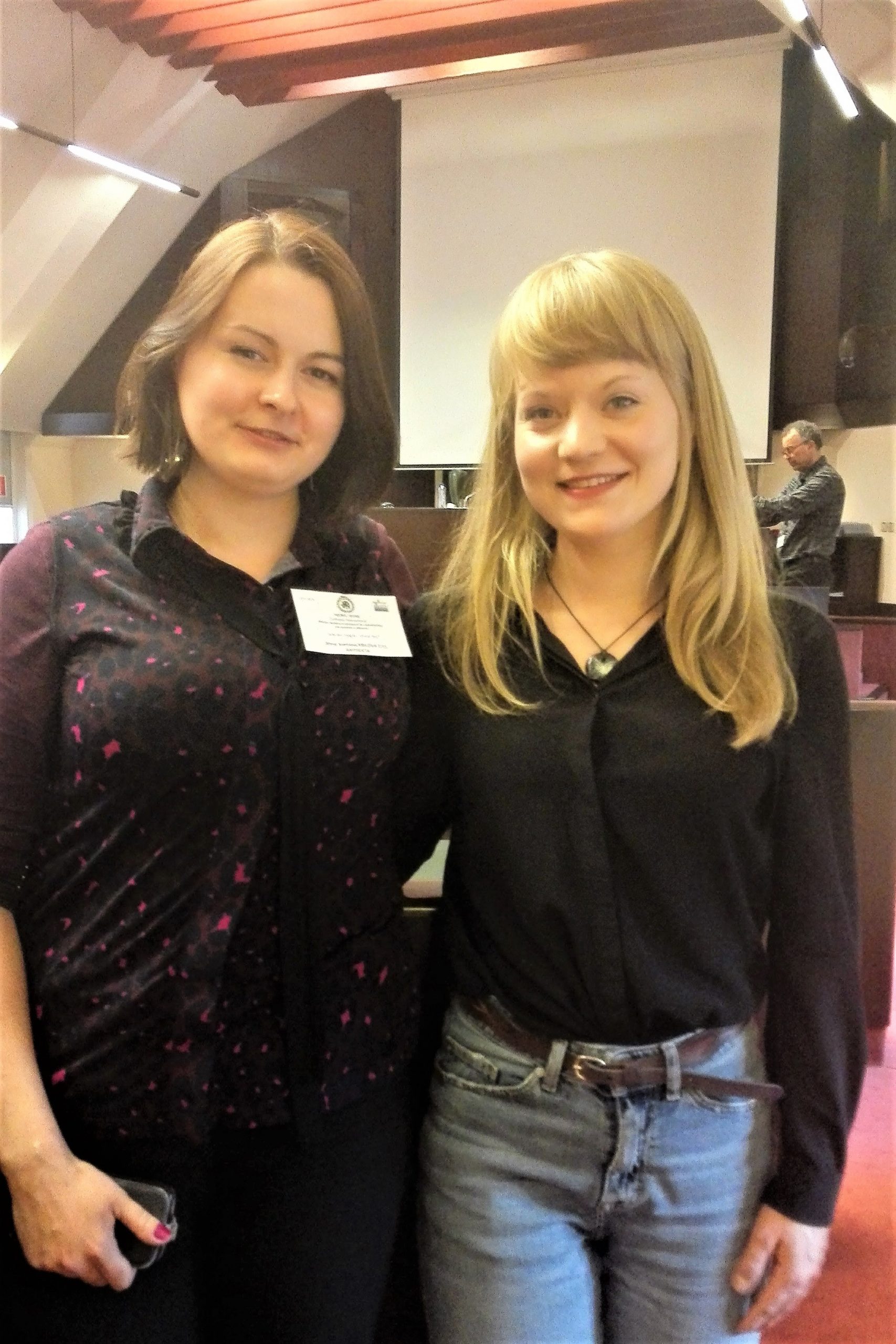
Svetlana Krilova and Laura Laukkanen at the Belgian administration building where the FECRIS conference was held.
In her speech, Véronique Roy from France spoke about a son who died in Syria in 2016 at the age of 23. About a year earlier, the young man had suddenly begun to radicalise. The family found it hard to understand at what point the process had begun. Their family bonds were strong, they respected freedom of religion and led an active, socially rich life. Roy mentioned that the family was later able to identify the two young men who had influenced the son most while he was still in France. Roy nevertheless wished that the family had had more information about the phenomenon in the past.
Anne Josso, Secretary General of the French government agency for monitoring groups that threaten public order, said that the backgrounds of radical groups differ greatly. The causes are also very varied, and different elements have to be taken into account. According to Josso, however, a sense of not being understood, supported or connected with others is what several radicalised people in France named as the reason the process began. Josso noted that radicalisation is often a way of searching for one’s own identity.
Jean-Pierre Jougla, director of the FECRIS Scientific Committee, said that if we want to understand how a person becomes radicalised, we need to understand the utopian worldviews built up around the subject. According to Josso, understanding of the phenomenon has grown, but more structures and training are still needed. The perspectives of all disciplines should be used so that we can understand the phenomenon better. Experience and knowledge need to be shared, and young people’s resistance to propaganda needs to be strengthened.
Alain Grignard, a lecturer at the University of Liège who also works as a police officer, noted in his talk that although such groups have succeeded in creating fear and uncertainty around us, we should aim to approach the phenomenon rationally rather than emotionally. According to Josso, in France, for example, people have become interested in the factors behind the phenomenon. They no longer want to be satisfied with seeing terrorists as simply insane; after the initial shock of the attacks, they wanted to understand the factors behind their behaviour.
The conference also heard a talk by lawyer and expert by experience Sophie Poirot about her life in a cult that was one of ten groups following an arbitrary guru. It was a very intense “therapy” run by the guru, which participants had to pay hundreds of euros an hour to attend. Under the influence of the cult, everything in life was regulated and controlled, and in the end the members were completely isolated from the rest of the world. Poirot followed the guru for 12 years and ended up in financial disaster. In the end, however, Poirot won a court case against the former guru.
Alexandra Stein, a social psychologist, doctor of philosophy and writer, also spoke at the conference. She specialises in the social psychology of dangerous social relationships. In her talk, Stein focused on describing a person’s attachment to a group, using attachment theory. Adults, too, tend to seek refuge in their close relationships when they face a threat. But attachment relationships are not always effective. In cults, the supposed provider of safety is often also the source of fear. Members can therefore be exposed to chronic stress or threat. The threat may be, for example, the end of the world or a member’s own family. Members may also be isolated from other social relationships. This pushes the person to seek protection from the group, which seems to be the only potential provider of protection. In reality, however, the source of the threat is the group itself.
Stein also introduces different parties to the subject and stresses in her presentation that information must be brought into all social structures. In her view, it is not enough to teach critical thinking. An ideologically neutral approach to group activity is needed. The level of knowledge among teachers in educational institutions should also be raised.
In addition to those mentioned, the conference included presentations from linguistic, psychological and legal perspectives, offering useful information on topics related to this field of work. As Professor Janja Lalich concluded at the conference, we still have a lot of work to do.
Based on materials by Laura Laukkanen
Source: uskontojenuhrientuki.fi (original in Finnish)
Translated from the Russian original with the help of AI. Read the original (in Russian).